Fordham GSAS: Grad. Life: GSAS
Showing posts with label GSAS. Show all posts

Sunday, December 16, 2012

Newtown Tragedy Horrifies and Enrages Fordham Graduate Students

     When I learned on Friday afternoon about the horrifying school shooting that had taken place that morning, I was in the staff lunchroom in the high school where I work in the afternoons. I was actually writing a post for this blog, about a new dating website for graduates called "Gradhearts." I quickly scrapped that post, for obvious reasons, and began to read about the event on the internet.
      It was hard to not to be viscerally affected by the news -- with laughing students milling around in the school library just yards away from me, and having recently just practiced the shooter on the premises lockdown drill in this school, all of the teachers and staff in the lunchroom were barely able to speak, choking back tears.
      Later in the day, as information unfolded about what exactly happened, and how and why it could have happened, the GSAS community began to respond to the shooting via social media. The response was, at first, to express shock, sadness, and bewilderment. Most everyone used words like "unspeakable," "unfathomable," and "incomprehensible," in their responses on Friday. Many, including me, had an extremely physical reaction, feeling sickened, nauseous, ill, and/or shaky.
     That day, Father McShane released the following statement:

    Dear Members of the Fordham Family,
    Our hearts are broken today by the senseless killing of children and adults—we are not yet sure of how many—at Sandy Hook Elementary School in Connecticut.
    Words like horror and tragedy almost lose their meaning in the face of such loss. The pain and sorrow of the victims’ families is unimaginable, and must be nearly unendurable.
    I know you all join with me in prayer for the souls of those who were killed, and for their loved ones, whose mourning is only beginning. Keep the grief-struck families in your hearts, and pray, too, for the healing of their community, and this nation, from this most grievous wound.
    Sincerely,
    Joseph M. McShane, S.J.

     As the weekend wore on, more of us began to come to terms with how we felt about this massacre: enraged, furious, saddened, heartbroken, fed up, disgusted. More of us began speaking out on social media, together working through the arguments and ideas about gun control, the Second Amendment, mental illness, mental healthcare, violence, media coverage, American cultural values, and even religion, God, and faith.
     Tonight, President Obama spoke at an interfaith memorial service and prayer vigil for the victims, delivering a moving and inspiring speech calling for change. Many of us are now responding to this speech, too, searching for a way to make meaning out of the senseless horror.
     As a community, I know we will continue to discuss this, and I hope we will not only keep the conversation going but also be moved to action. I hope the GSAS family can contribute positively and constructively to this call for change in our social policies and cultural values. I give all my love, thoughts, prayers, and hope to the families and community members affected by this tragedy.
     The faces of the 6 and 7 year olds who died, and the faces of the teachers who died trying to protect them, are flashing now on my TV screen. It is too sad. I try to think about their families and I get sick again.
     I try to think about the survivors -- the children and teachers who were in the next room, or the room down the hallway, as their friends and classmates and co-workers were murdered. I am heartbroken for them, too.
    My job at the high school I mentioned above is to provide academic and behavioral support to one of my students with autism. I feel deeply, too, for him, hoping that the emerging coverage related to this tragedy about Autism Spectrum Disorder-- the disorder that makes his life so much harder than his friends' lives --  won't make people afraid of him or others who also struggle with it.
    More to say, of course... but for now, good night. -- Liza

Monday, October 1, 2012

October Days in the GSAS


Happy October!
       Here are some upcoming events to put on your calendar for this month! I will feature more events as the dates get closer.
      On Friday, Oct. 12, the GSAS will hold its annual Scholarships and Achievements Celebration. Congratulations to all recipients -- you've worked so hard, and here is your chance to be honored and to celebrate! Join the GSAS in the Lowenstein Building at Lincoln Center, in the 12th Floor Lounge. The event begins at 6:30pm.  
       On Monday, Oct. 15, the Center for Medieval Studies will be sponsoring a lecture by Dr. Liesbeth van Houts, history professor, fellow, and director of studies at University of Cambridge. The talk, the second of the Medieval Studies' Lecture Series this semester, is entitled "The Fate of Priests' Sons c1100, with Special Reference to Serlo of Bayeux." Dr. van Houts specializes in Medieval History and Latin, Anglo-Norman history, medieval historiography and literature, and gender studies in the Middle Ages. According to her university profile, she also enjoys hiking in Wales and reading contemporary Dutch literature -- I wish I could go on a hike with her and find out more about her amazing career and discuss the colonial ghosts in Dutch novels! The talk begins at 5:15pm at McGinley Center, Faculty Lounge -- check it out! 
       Next, Fordham's Latin American and Latino Studies Institute will host a lecture on Wednesday, Oct. 17, by Dr. Barry Carr, entitled "Rebels, Revolutionaries, and Exiles." Dr. Carr is one of the top scholars in the field of Latin American studies, with special interest in the cultural, social, and economic histories of Mexico, Cuba, Central America, and the Caribbean. He is currently teaching a course for the LALS as a visiting professor; his course is entitled "Testimony and Revolution in Latin America: Reading Testimonios by Women and Men Activists from Central and South America, 1960-1992," and we welcome him to Fordham. SPECIAL NOTE: The LALS will be holding a Welcoming Reception for Dr. Carr tomorrow evening, Oct. 2, at 5pm in the McGinley Center, Room 236. But even if you can't make tomorrow's reception, be sure to put Dr. Carr's Oct. 17th talk into your calendars! 
       These events are sure to enrich your October here in the GSAS. Let me know if you plan on attending any of them! Plenty more to come from Grad.Life this month! 
         In the meantime, enjoy these first days of one of my favorite months of the year! 
---- Liza 

Friday, September 28, 2012

Feature: The Fordham Graduate Digital Humanities Group


Good morning, happy Friday to you.
    As a blogger for the GSAS, and as a professor of an on-line English course this semester for the PCS, I have been especially aware and appreciative of how the digital age has been dynamically changing and influencing the institutions of higher education and graduate programs worldwide. In the spirit of this digital renaissance, I would like to introduce this blog's readers to the Fordham Graduate Digital Humanities Group. Officially recognized by the GSA as a Working Group, anyone in the GSAS can participate and benefit from the great work that this group does for the university!
   The GDH meets twice per month to learn and sustain a conversation about the development of digital technologies in the humanities disciplines. (Check out the Schedule page for info about future meetings and events!) The group focuses on graduate studies and professionalization issues, which is of particular interest to me personally and most Grad.Life blog readers! As the GDH's Wordpress blog says, "This group should be of special interest to students who are preparing for a professional academic career in the humanities, a career that most likely witll require digital fluency in regards to teaching, research, and publishing." This past week, the group led a workshop on digital pedagogy and discussed everything from practical issues (eg, paperless teaching, digital classroom tools) to the theoretical idea of defining the concept of "digital pedagogy." 
   Coming up for the group is a workshop open to all GSAS students entitled "You Online: Developing Your Online Academic Presence," to be held on November 7th, 2012. It will be led by Michael Mandiberg in the Flom Auditorium in the Walsh Library. The half-day event should prove to be extremely beneficial in giving GSAS students practical tools, ideas, and resources to help establish their on-line academic profiles and presences. (See this blog's post on the same topic from last semester!) 
   There's also a CFP sponsored by the GDH for the Fordham Graduate English Association Interdisciplinary Conference in March 2013. The conference is entitled "Remembering, Forgetting, Imagining: The Practices of Memory," and the GDH's CFP provokes a fascinating cross-discipline question:  "Do digital platforms change the way we remember?" Already just from this one question, I find myself excited to attend this conference and this panel presentation -- and it may become a future topic for a post on Grad.Life! For now, check out the full CFP for details about the topic and format, because the deadline in November 15 -- you have plenty of time to get some ideas together and submit an abstract! (Upcoming post on this blog will also feature more about this wonderful interdisciplinary grad conference -- watch for more info or click on the link above to the conference homepage in the meantime!)
   Make sure to check out the group's blog and Facebook page (click "Like") for more information on this important and dynamic organization in the GSAS! 
   (While you are on FB, visit Grad.Life's page and click "like," too!)
   Until next time, Liza 

Tuesday, September 18, 2012

Topic of the Day: The 5-Year Plan

Hello Readers!
   I hope this Tuesday finds you well! I am actually blogging today from an airplane -- whoohoo! I love in-flight wifi!!
   Since I have recently been thinking a lot about my personal future and about how amazing and crazy life's twists and turns can be, I thought today would be a good day to broach the topic of how graduate school fits into one's life as a whole -- in other words, how it fits into, or doesn't fit into, your grand plan for life. If you are not familiar with graduate school life, or maybe if you are just starting out as a degree candidate, you should know that life does not stop for graduate school. Despite enrollment, courses, classes, papers, dissertations, comps, exams, and tuition, life, indeed, keeps occurring. I have known colleagues who have fallen in love, gotten married, bought houses, had children, gotten divorced, traveled, climbed mountains, ice-skated in national competitions, played in rock and roll bands, and achieved other typical and non-typical life milestones all while working towards their degrees. Life rolls on around us, and most of us treat graduate school just as if we would treat a regular job -- we work, we play, and we live our lives. The only thing that is different than being in the non-academic working world is that there is an ending to grad school. And even then, life doesn't really change that much.
   Immediately when I decided to write about this topic, I thought of Dr. Karen's 5 Year Plan. For those of you who don't know Dr. Karen, allow me to introduce you to her website, The Professor Is In. A colleague of mine had passed her site along to me a while back, and it provides a gold-mine of  information and anecdotes and advice that will give interesting and candid perspectives about the academic world. Dr. Karen's perspective on the 5 year plan is basically that while you can't expect to control everything in life, you can however take charge of your career and make choices based on your own personal goals. She writes, "I don’t think anybody should ever be in graduate school, or on the tenure-track, without a five-year plan," and continues:
"Some of my clients are masters of the five-year plan, and even have things like getting pregnant in there. I admire that, even while I know that 'the best laid plans…' You can’t plan for everything (or, you can, but your plans may not work out). But the core point of planning is this: that you’re taking control of your process into your own hands, and not leaving it out there somewhere, in the hands of your advisor, your department, or 'fate.' You decide when you’ll write, when you’ll defend, when you’ll publish, and so on. These are all your decisions to make."
   What Dr. Karen is sure to point out, though, is that a plan in and of itself is not going to get you anywhere. You have to stick to the plan. In other words, you have to meet deadlines. In a follow-up post, Dr. Karen asserts:
"Staying on top of deadlines is exactly what allows a person to achieve  huge life goals. Yes, I’m quoting Thomas Edison:  ”success is 10% inspiration, and 90% perspiration.”  The people who succeed in getting into the national conference are, first and foremost, the ones who actually remember to submit the proposal to the national conference, by the deadline, properly formatted. One of the most important outcomes of the 5-year plan is that you never miss a submission deadline for a conference or a funding opportunity.  As you learn of new conferences and funding opportunities, you simply add them in, without losing track of the other deadlines. You also plan out a publication schedule, and put your own deadlines for submission to journals there in the plan.  And money racks up, and publications rack up, and networks rack up, and voila, the cumulative effect 5 years later is—an epic CV that gets you an epic job offer, or tenure."
    Ok, well, yes, but never miss a deadline? "Simply" add them in? It sounds great in theory, but I think the biggest problem most graduate students have is that meeting deadlines is not at all simple. Life sometimes tears you away, even if your academic work is your number one priority. It is not always so black and white.
    So what are your thoughts on the 5 year plan? Though I may have some theoretical questions about how the 5 Year Plan works, most of my questions about creating a 5 Year Plan are entirely logistical -- meaning, what does the plan actually LOOK like? By this I mean literally how does it look? What format does it take? Is in in calendar form? List form? Do you try for a month-by-month set of goals, or set up it up year by year? Or something in between? Do you work on multitple goals at a time, or try to nail one thing down before moving onto the next? I'm sure different solutions work for different people, but I am wondering what would work for me, and what has worked for you? I'm curious to hear your thoughts!
    And another thought I always have when I revisit the 5 year plan post: how do you know if your goals are realistic? Is there such a thing as shooting too high? Should your goals be based on practical things such as making money and attaining a job with benefits, or should the goals be focused on advancing the scholarly conversation? How do you set yourself up for success with the 5 Year Plan?
   Please share your thoughts about how grad life fits into your big picture!
Until next time, Liza

Monday, August 6, 2012

Upcoming August GSAS dates; Thoughts on Penn State punishment

Hello Readers!
Welcome to August! We are in the home stretch of the "summer" -- Fall classes begin in less than a month! I hope everyone had a good summer session, whether teaching or taking a course. A couple of tidbits for you to chew on this week:
  • For all students in the GSAS, incoming and returning, the annual Welcome Back Rooftop Social will be held on August 28th. Click here for the Facebook Event invitation, and click "Join"! I have always enjoyed the Welcome Back Social -- a time to reconnect with everyone and gear up for another tough semester. It's nice to be in the library with other people instead of buried at a solitary desk under a pile of books amongst the stacks. Come one, come all! Put these events on your calendar -- this summer is going fast, and these dates will be here before you know it.
  • In university news around the nation, a big story that hit the airwaves several weeks ago was the Penn State punishment for its role in concealing the sex crimes committed by former coach Sandusky. (Check out The New York Times report on the story here.) Since then, there has been plenty of opinions and discussion about the severity of the punishment -- some editorials have come out saying the punishment is too lenient; others point out that the punihsment does nothing to put right the wrongs against the victims. Two days ago, President Obama spoke out on the subject in a radio interview in Ohio, asserting that the punishment fit the crime appropriately. Personally, I agree that the punishment should be harsh for the institution as whole -- this kind of thing must NEVER happen again -- but many Penn State graduates/ alumni fiercely oppose the punishment, outraged that the penalties hurt too many of the current and future students. As I read the coverage about the reactions from alumni and current students, I tried to put myself in their places -- if an institution with which I was or had been affiliated had committed such crimes of concealment, how would I feel? How would that change my own view of my held or pending degree, and how would it change the view of my degree by prospective employers or publishers? What do you think about the punishment? Leave your comments below.
Thanks for checking in! Until next time, Liza Z. 

Sunday, March 25, 2012

Communitas '12 on March 30th


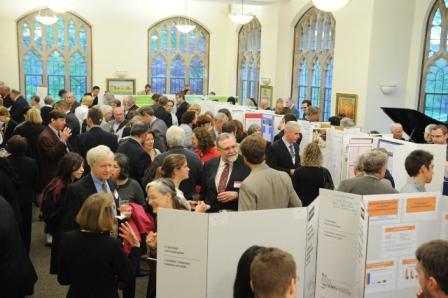
      It seems it would be slipshod of me as the GSAS blogger not to mention the special GSAS event that is coming up at the end of this month! On March 30th, the GSAS will hold its annual Communitas ’12 and Spring Gannon Lecture event!
     Here’s how the schedule breaks down:
     Starting at 12:30pm, student presenters from every department will be presenting their work, from recent and current research projects, in the Walsh Library. Click here for the schedule of presentations! 

      At 5:30pm, there will be a Dean’s reception in the Walsh Library Atrium, where the presenters will be exhibiting their research posters and videos. Last year’s winning entries are posted on the GSAS Research Competition webpage. I just browsed through the projects – they look amazing! It definitely is inspiring to see the work of my peers, not only in my department but throughout the entire GSAS, displayed and showcased for a larger audience. Communitas provides a nice space for graduates to take pride in their projects that their blood, sweat, and tears have gone into for probably months and maybe even years.
       Then, at 6:30 pm, everyone will move into the Flom Auditorium for the Spring Gannon Lecture. Unfortunately, I hadn’t previously known this event existed, but after learning about it, I realize that it is such a wonderful opportunity for GSAS members to gather together and enter a conversation about a timely and important cultural topic. According to the GSAS website, “The Gannon Lecture Series, which began in the fall of 1980, brings distinguished individuals to Fordham to deliver public lectures on topics of their expertise.  Fordham alumni endowed the series to honor the Rev. Robert I. Gannon, S.J., president of Fordham University from 1936 to 1949, who was an outstanding and popular speaker.” (1980! That means the lecture series is as old as this blogger!)
       This year’s lecture topic sounds like it will be a fascinating and timely topic. The lecture is entitled, “Sandstorm: Interpreting the New Middle East and North Africa” and will be given by Dr. Kamal  Azari, GSAS ’88, and Dr. John P. Entelis, Prof. of Political Science and Director of Middle East Studies program at Fordham. (By the way, I went to the Middle East Studies webpage on the University Website – it looks like an amazing program!) Both Dr. Azari and Dr. Entelis will surely bring out important perspectives on political, social, economic, and cultural issues related to the Middle East and North Africa.  

       The question I want to ask now is this: What can we do as a community to encourage more consistent and wider attendance at these kind of events, which will surely benefit all who attend, either professionally, academically, or intellectually? From my experience, I feel as if being a part of the GSAS community as a whole wasn’t and isn’t presented as a priority or even an expectation as I began my coursework years ago at Fordham. Readers, do you agree? Was this was just a personal experience unique to me – did my own actions (and non-actions) cause me to miss out on these GSAS wide opportunities? Or is it a larger issue? And, is this something we as a whole should work to correct? How important is service or participation to the GSAS as a whole in comparison to serving and participating within our departments? I’d love to hear your thoughts! 
       In the meantime, I hope to see you at the event!