Fordham GSAS: Grad. Life

Thursday, March 29, 2012

Professionalization: A Vital Part of Graduate Education


At the time when I applied to graduate school, I really didn’t know anything about living in the real world. Maybe undergraduate life was too disconnected from the real world to give me any inkling. Not that my undergrad years were easy and breezy – I had 3 campus jobs throughout my years at college, and no car, and no material luxuries. But there was very little discussion about what it meant to take your college degree out into the real world. For me as an English student, I think my undergraduate work allowed me to be swept up in the romance of literature and writing. I came from a working class family, but I guess somehow I believed that getting to college was already the pot at the end of the rainbow. 
In fact, all I really knew was that I loved books and literature and wanted to keep studying in that field, and that I thought I would love to be a professor in an English department one day. So after a year of working at an office job, I left corporate America and applied to English grad programs. I didn’t really have a plan; I thought I would figure it out as I went. Well, it turns out, according to most advice pieces in The Chronicle and elsewhere in blogs on the web, that I was all wrong --  I went to graduate school for all the wrong reasons, without having the proper means, and without a clearly mapped out career plan, all to my eventual detriment, apparently.
The “right reasons” to go to graduate school are, according to these advice-givers, to get a job. (Not because you "love" literature.) Job getting is the main objective. This, of course, makes very practical sense, but if you don’t know anything about the field, or about academic life and professionalization in general before you begin graduate school, then logically you’d have to learn about it when you get there. But do we, as graduate students, learn what we need to know about getting a job when we start graduate school? Wouldn’t it be a great idea if graduate school education from day one included in its curriculum – in fact, made mandatory in its curriculum – a practical course in professionalization in the field?
Now, for a minute, let’s compare and contrast Arts and Sciences graduate degrees to other forms of post-Bachelor degree education, thought of as “professional degrees,” such as JDs and MDs. Medical students have a clear path of professionalization built into their programs; law students, on the other hand, do not.  I’ve heard lawyers and law school graduates complain that law school has absolutely nothing to do with the practical, day-to-day job of being a lawyer. It seems absurd that such elaborate education systems would get built that do not directly feed into the job market that requires the degree.
It is the same with Arts and Sciences graduates – there is almost nothing that was required of me as a graduate student that pro-actively prepared me for the job market. Assignments and projects – and more precisely the A, A-, B+, B grading systems that went with these assignments – do nothing for students to prepare them for eventually getting a job in the field.
Here’s what I’m imagining: a mandatory professionalization curriculum that requires students to demonstrate and generate knowledge of the basic arc of an academic career, starting from someone’s first semester as a PHD student to – well basically the end of his or her life! This curriculum would provide information about the conventional path through graduate school as well as encourage students to explore how that arc can be modified and altered, inviting students to identify alternative career pathways and end-goals that can be reached when starting a program. The curriculum should ask students to outline possible career paths, and to research and become experts in the market, and to understand what the academic world is all about. In addition, spotlights should be put on the mechanisms of conferences, publications, committees, dissertation writing, applications, interviews, and self-identity within the field. 
Then, aside from this curriculum addition, the assessment system in the existing courses needs to be totally changed in order to promote marketability. Getting an "A-" means nothing and will do nothing to help you get a job.  Instead, incorporate professionalization into the curriculum itself. Require us to submit papers to conferences, and to prepare articles for specific journals and CFP's.  Have those submissions (and acceptances) be the basis for grades and course fulfillment. Have mock mini-conferences within the seminar, or join forces with other seminars to have bigger mock conferences across the department. It is through these forums, rather than seminar papers alone, that students should be evaluated and critiqued and assessed, with an eye to marketability and credibility in the field. Sources and methodology should be scrutinized, and presentation skills, either oral or written, should be constructively critiqued, helping students to prepare to publish, speak at conferences, and complete the dissertation.
I believe that this vital part in the education of graduate students had been overlooked in the past because there was perhaps no real need for it, when the supply and demand for PhDs was more balanced. But I don’t see how it can continue to be overlooked.To be fair, many of my professors tried to incorporate elements of professional skills into coursework, but as a whole I think more can be done systematically to make a greater impact.

What do you guys think? What can we do to help transform what needs transforming insofar as embedding professionalization into curriculum?

Sunday, March 25, 2012

Communitas '12 on March 30th


      It seems it would be slipshod of me as the GSAS blogger not to mention the special GSAS event that is coming up at the end of this month! On March 30th, the GSAS will hold its annual Communitas ’12 and Spring Gannon Lecture event!
     Here’s how the schedule breaks down:
     Starting at 12:30pm, student presenters from every department will be presenting their work, from recent and current research projects, in the Walsh Library. Click here for the schedule of presentations! 

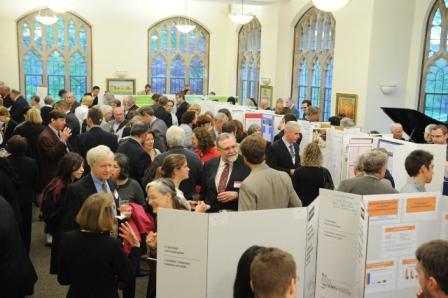
      At 5:30pm, there will be a Dean’s reception in the Walsh Library Atrium, where the presenters will be exhibiting their research posters and videos. Last year’s winning entries are posted on the GSAS Research Competition webpage. I just browsed through the projects – they look amazing! It definitely is inspiring to see the work of my peers, not only in my department but throughout the entire GSAS, displayed and showcased for a larger audience. Communitas provides a nice space for graduates to take pride in their projects that their blood, sweat, and tears have gone into for probably months and maybe even years.
       Then, at 6:30 pm, everyone will move into the Flom Auditorium for the Spring Gannon Lecture. Unfortunately, I hadn’t previously known this event existed, but after learning about it, I realize that it is such a wonderful opportunity for GSAS members to gather together and enter a conversation about a timely and important cultural topic. According to the GSAS website, “The Gannon Lecture Series, which began in the fall of 1980, brings distinguished individuals to Fordham to deliver public lectures on topics of their expertise.  Fordham alumni endowed the series to honor the Rev. Robert I. Gannon, S.J., president of Fordham University from 1936 to 1949, who was an outstanding and popular speaker.” (1980! That means the lecture series is as old as this blogger!)
       This year’s lecture topic sounds like it will be a fascinating and timely topic. The lecture is entitled, “Sandstorm: Interpreting the New Middle East and North Africa” and will be given by Dr. Kamal  Azari, GSAS ’88, and Dr. John P. Entelis, Prof. of Political Science and Director of Middle East Studies program at Fordham. (By the way, I went to the Middle East Studies webpage on the University Website – it looks like an amazing program!) Both Dr. Azari and Dr. Entelis will surely bring out important perspectives on political, social, economic, and cultural issues related to the Middle East and North Africa.  

       The question I want to ask now is this: What can we do as a community to encourage more consistent and wider attendance at these kind of events, which will surely benefit all who attend, either professionally, academically, or intellectually? From my experience, I feel as if being a part of the GSAS community as a whole wasn’t and isn’t presented as a priority or even an expectation as I began my coursework years ago at Fordham. Readers, do you agree? Was this was just a personal experience unique to me – did my own actions (and non-actions) cause me to miss out on these GSAS wide opportunities? Or is it a larger issue? And, is this something we as a whole should work to correct? How important is service or participation to the GSAS as a whole in comparison to serving and participating within our departments? I’d love to hear your thoughts! 
       In the meantime, I hope to see you at the event! 

Tuesday, March 20, 2012

"You're Doing Great" and other fantasies of grad life...

Hello Grad Students!
Today I've been thinking a lot about graduate conferences, most likely because I am presenting at one on Friday at the CUNY Graduate Center. The conference is entitled “Cripples, Idiots, Lepers, and Freaks: Extraordinary Bodies / Extraordinary Minds" -- it's an interdisciplinary conference that aims to look at literature, media, culture, problems of representation, and social practices through the lens of disability.
 Although I've helped organize a grad conference before at Fordham, and attended several over the years, I've never actually presented at a grad conference -- I'm so excited for the experience! I'm happy that this one is in New York City, and that I'll get to meet some great graduate students from across the city and beyond.
To me, grad conferences provide safe spaces to be bold, to try out styles of speaking and writing and interfacing, to learn to believe in your own thoughts, reactions, and responses, and to challenge yourself. I'm excited because I always find conference weekends to be so invigorating, both intellectually and emotionally.  There's something about the way a conference works that stretches me, that allows me to think in new ways, and that makes me find a renewed commitment to my work and field. Depending on my mood, I find it possible to be anonymous, and sit in the audience and think and listen, or to talk, try out ideas out loud, and make connections with people.  I find myself scribbling questions that I try to formulate as I listen to the speakers and make thoughts cohere. It's a very energizing and motivating experience for me.
There's been some talk in The Chronicle blogs about different types of conferences -- oh yes, leave it to us academics to categorize, classify, and analyze our own professional formats and venues! We've got it all divided it up by specific criteria: On what scale does it take place: nationally, regionally, or locally?  Who's participating -- professionals, graduates, or both? What kind of subject matter -- general or specialty? Is it organized by a department, a society, or a school? Is it organized around a theme, text, or author? Does it focus on a critical school of thought? Is it interdisciplinary? Will there be a publication that results from it? Who will you meet? What new ideas will you get?
All fun-poking aside, I actually do find it interesting to think about the dynamics of the "conference." Individuals tend to see the benefits of a conference according to his or her personality: some like the networking, collaboration, and the opportunity to get in front of audiences; some like the opportunity to think and have one-on-one discussions over the lunch or dinner breaks.
Interdisciplinary events have been key for me to expanding my horizons and thinking about my field (American lit) in new ways. Fordham, I feel, is pretty good about offering interdisciplinary events for the graduate community. (That reminds me -- the Communitas Event is coming up March 30th -- check here for more info about the Research Competition and the Ganon Lecture.) But I think always more can be done -- for example, my project on mental disability and literature could probably benefit from talks with neuroscience, biology, and philosophy grad students, to name just a few! I am fascinated by possibilities of stretching the boundaries of what we already know, of ways we know how to be.
One last note -- I've been thinking a lot about the purposes of professionalization as a grad student, and what some goals could be for myself at this conference coming up. I had a random idea today during yoga class, actually. I was in a particularly difficult pose that made me lose my balance a bit. As I stumbled out of the pose, someone next to me whispered, "You're doing great." As he said these kind words, my mind did a strange thing: it sort of immediately and unconsciously produced an image of myself at the conference. In the mini-movie in my mind that had suddenly appeared, I saw myself fumbling an important point in my paper, and the person next to me at the panel table whispered, "You're doing great."  The thought came up through the subconscious so clearly and vividly and unintentionally that it almost made me laugh. I mean, the class leaders always say that the class will draw out the bad stuff going on in your life, and I've definitely had emotions come to the surface during class before, but never had such a concrete narrative scenario risen to my mind's eye. I guess it made transparent some insecurities I have about presenting my work in public, but it also was a pretty clear wish for the same kind of encouraging, comforting and supportive environment in my work life that I enjoy in the yoga studio.  Afterwards, though, I got to thinking -- hey, why not? Why should the grad conferences be the safe spaces that help prepare us for the real academic world -- why shouldn't it just be like that always? Maybe the vision came to me as an intention to transform the post-graduate school world into a space that can also provide a warm kind of support that graduate conferences offer us?  Maybe the vision was telling me to use the CUNY Grad Center conference this weekend as a chance to extend my congratulations, or encouragement, or praise, to someone else. Maybe we graduate students can take this opportunity now, during this relatively short time in our careers, to use the grad conferences we create and participate in to help transform the future of our professional world and the way our profession works. Why not? It's up to us, after all, to decide what kind of world we want to be in.

-- Liza

Thursday, March 8, 2012

W.W.B.S.D.


Hi Grad Students,
My favorite (rock and roll) artist released an album this week.  On Tuesday, Bruce Springsteen’s Wrecking Ball, in glossy black vinyl, arrived at my fiance’s apartment, via U.S. mail, and a digital version I had pre-ordered was uploaded onto my laptop, via I-tunes.
www.brucespringsteen.net/albums/wreckingball.html
 Springsteen always speaks to me in my time of need. I remember reading an article once in Time Magazine in which Natalie Maines of the Dixie Chicks said that sometimes, when she isn’t sure of what to do in life, she asks herself, “What would Bruce Springsteen do?” and it usually helps her out of a dilemma, and guides her down the wiser road, or helps her find the strength to choose the road less traveled. This method of self-monitoring has often worked for me, too. His messages are in his music, and in his living example, and in his honest creation of characters that explore what it means to be an adult, an American, a human. In Wrecking Ball, the message is timely and urgent.
I was in desperate need of a little Springsteen, this week, actually, after sifting through archives of The Chronicle and finding, and reading, in its entirety -- in an act of what in retrospect I might describe as insane masochism -- an article entitled: “Graduate School in the Humanities: Just Don't Go.” (I should mention that I also continued the masochistic episode and further increased the despair by reading “Just Don’t Go, Part Two.”) 
The article brings to mind a scene from the movie The Wedding Singer, when Adam Sandler’s character snarls to his ex-fiance who has left him at the altar and is now giving him reasons why she as fallen out of love with him: “Once again, things that could've been brought to my attention YESTERDAY!”
Sigh…. If you are one of the GSAS students in one of the humanities departments, you may know how I am feeling after reading that article. Thank goodness this episode of self-torture coincided with the release of Wrecking Ball. In the album, Springsteen’s characters are angry and anguished about the promises of the American dream being shattered, but also defiant and resilient. Rolling Stone reviewer David Fricke said one of the songs is like a “dance through the ashes” of the “scorched earth” that America has become, and that the record reminds us that we still have the power to sing and create.
Springsteen resounds, “Take you best shot, show ‘em what you got, bring on your wrecking ball,” and I imagined somehow channeling all my fear and bitterness and sadness and anger that arose after reading the article and somehow standing up to the world, without regret, doing whatever it is that I do here in grad school and in work and in life, and telling the crushing reality of life to come and get me, because in the end life is the journey, not the end product.
After reading the dismal and gloomy and soul-crushing article mentioned above, searching for a way to quell my despair, I asked myself, “What would Bruce do?” In his new album, he tells me what to do:
The lyrics of “Wrecking Ball” remind us that our “steel and stories” will one day “drift away to rust,” and our “youth and beauty” will be “given to the dust,” and that although we may win or lose, we all are “burning the down the clock,” and that “all our little victories and glories” will “turn into parking lots,” and that since this is the nature of humanity, we have nothing left to do but stand up and say, bring it on. When you’ve been flattened, you dance through the ashes. You keep going.
‘Til you’re done. Yes. Onward and onward, folks. Until next time, Liza

Saturday, February 25, 2012

Part Two of "And the Oscar for Best Grad School Movie goes to..."


       OSCARS! In honor of this day, I’ve devoted a two-part blog to the representation of graduate school in Hollywood films.
       So, as you noted from Part One, there aren’t so many movies set in graduate school or even with grad students as characters. To recap, most films that people come up with when asked this question feature LAW or MED school students, but not arts and sciences PhD students.
      I think I assumed there were at least a few good ones, because I rationalized that I must have had some kind of image in my mind about what graduate school “looked like” before I… signed up for it. I assumed that that image came from either novels or movies. But after some investigating, I realized this “image” must have come more from novels than movies, or maybe just from something that I made up in my head based on romantic ideas of scholarship and academia that came from the pleasure I take in reading and being alone in a library.  Wherever I got my “ideas” from, it probably wasn’t from movies, because, the truth is, there just ain’t that many movies out there.
       That said, with a little digging, I was able to come up with a list of my own with some additional titles on it for us to check out. I haven’t seen all of these, so I won’t attempt to rank them or call it my “Top Ten” or anything like that. But, here’s a little filmography of movies featuring some element of graduate school. Criteria for this list: the movie has to have a character that either is, or was, a graduate student during, or just previous to, the action of the movie. Alternatively, if the character refers to graduate school in a significant way (teaching perhaps?), or was significantly shaped by graduate school, meaning that he or she is living a scholarly life that reflects a graduate school education, I also included the movie. Finally, the said graduate program cannot be law or med school.
        Proof (2005): I don’t want to give away the plot, because it is a great little movie if you haven’t seen it, but the film involves graduate level math work that, within the world of the movie, would revolutionize the mathematics world. Originally a play.
        Possession (2002): main characters are literary scholars in pursuit of the identity of a famous Victorian poet’s lover to whom he wrote beautiful letters.
       The Addiction (1995): main character is a philosophy grad student turned into vampire! Sounds amazing!
       The Shape of Things (2003): Features a romance between an English lit major and a graduate art student. Also originally a play.
       The Last Supper (1995): A group of graduate students host a series of murderous dinner parties during their summer break. Seems like an interesting representation of grad students!!
       Tenure (2009): Not exactly grad life, but in this film, with the young professors trying to get tenured, it has the atmosphere of grad school.
      Marathon Man (1976): Never saw this but apparently, according to IMDB, Hoffman’s character is a history grad student.
      Wonder Boys (2000): Can’t remember if these students are undergrad creative writing students or MFA students, but either way it has the intense feeling of what I would imagine a competitive MFA program to be like.
     PHD the Movie (2011): Piled Higher and Deeper, our favorite grad-school comic, made a movie this year! Making the rounds at Universities all over the country – expect witty and satirical portraits of grad life, just like the comics.
      Naturally Obsessed (2009): Documentary, not fiction, it follows the life of grad students in the microbiology department of Columbia University. Seems like it might be a good one to watch!
      Okay, so maybe all of these aren’t “grad school movies” the way Animal House, Rudy, St. Elmo’s Fire, and With Honors are “college movies” – but you get the idea. If you've seen any of these, write in and let us know how accurate the depiction of grad life is!!!
     To conclude: On a message board thread about this very topic, a poster asked, “Given the types of people who go to grad school and the life drama that ensues there, I'd think grad school days would be rich fodder for fiction/fictionalized memoir. What am I missing?” This question parallels the one I proposed in my last blog entry. The response to this post, by someone (with the handle “Brain Glutton”), also parallels some of what I was thinking as I realized that most “grad school” movies featured law or med students:
“Audience appeal. If the subject the characters are studying is an important part of the drama -- and it is, to real-life grad students -- then the scenario is too intellectual for most people -- too intellectual for most intellectuals, in fact, if involves a grad program outside their own field of expertise. To make it accessible, you have to make it about a law school or med school, something that produces professionals whom the average person has to deal with, and who do things the average person understands at least in general principles.”
          There are a couple of points here I’d like to discuss. First, I love how Brain Glutton doesn’t pull any punches. She, or he, answers right off the bat – What’s missing? “Audience appeal.” BAM. Right across the face. Then we get the assessment explaining why a movie set in graduate school would lack audience appeal: “Too intellectual,” not “accessible,” not dealing with “things the average person understands.” This reasoning assumes at least two things: that movies are usually made to appeal to the widest audience possible (which is probably true); and that academic intellectual pursuits are not widely appealing (which is probably true in the US at least.) Hence, therefore: movies about academic intellectual pursuits are not usually made. There’s a great little syllogism.
       What do you readers think about this assessment? I would love to hear your thoughts! 
       
       Enjoy Oscars Night!!! Make sure to fill out your scorecard!! Until next time, Liza

Wednesday, February 22, 2012

And the Oscar for Best Graduate School Movie goes to....


       It’s Oscar Week!
       As the red carpet events draw nearer by the day, as I’m making sure I’ve read and considered all predictions and arguments, as I double-check my Oscar scorecard and consider last minute changes, wondering if Jessica Chastain and Octavia Spenser (both brilliant) will split the voters for The Help and allow Melissa McCarthy (human and hilarious) to take the category, wondering if a dark horse like Nick Nolte will surprise everyone, wondering if the lovely adventure in literary nostalgia Midnight in Paris has a chance to take home a statue, as I look forward to Sunday to settling in with pizza, wine, and popcorn for one of my favorite nights of the year, I begin happily reflecting.
        I reflect on the years past when I have always made time to watch this event, even when movie years hadn’t been particularly exciting, or when the nominees hadn’t reflected the truly inspiring movies of the year, or when I hadn’t even had time to see any movies during the entire year. I reflect on the movies I am grateful to have seen this year, taking time from my graduate studies to escape into the magic of Midnight in Paris, the laughter of Bridesmaids, the triumph of The Help, the enterprise of Moneyball, the catharsis of Warrior, the soaring spirit of Harry Potter and the Deathly Hallows.
       I think about the movies I have yet to see, one of which I may choose as a reward for myself in the coming months as I finish a chapter, or present at a conference, or complete a dreaded and toilsome task such as doing my laundry.
       Finally, as I close my books from the day’s work and settle into my pajamas, sinking into the couch, I begin thinking about how the movies have always helped me reflect on my own current station in life. I think with awe about the enormous, undeniable debt that Hollywood screenwriters, directors, and producers owe to the institution of graduate school, having over the years inspired countless creative and poignant cinematic explorations of the trials, tribulations, triumphs, hardships, heartaches, hilarity, incidents, accidents, and ultimate life-affirming redemption in the life of a graduate student.
       Or… err, um…. My reflection comes to a screeching halt as I bolt upright on my couch. Well, okay maybe not countless… but there are some, right? I mean, at least a dozen or so good movies? about graduate school?
       I’m sure I’ve seen some. As I reel through the movie-memories in my brain, I sort through all the undergrad movies and boarding school movies and law school movies and… hmm.
       But I’m sure I’ve settled in for a good rom-com between two grad students falling in love…. for a hefty drama about someone’s nervous breakdown leading up to his dissertation defense…. a twisted absurd surrealist depiction of the way graduate school propels a soul into the next realm of existence and possibility….
       Um. Well actually… Let me Google this.
       How pleasantly surprised am I to see a list come up! “The 7 best grad school movies of all time.” Okay, I say, here we go. As I click on it, I think dubiously, “Seven?”  Then I force the doubt away. Seven: yes. I mean, it’s not 10, but “Top Ten” --  that’s an arbitrary convention anyway. Okay, so let’s go with seven! Seven great movies dedicated to exploring the idiosyncrasies and uplift of graduate life. I fold my legs crisscross under me and pull my laptop onto my lap.
       Already as I read the intro, I like what I see. The author boldy asserts, “But what about those movies focusing on graduate-school living and the difficulty of appearing classically sharp while subsisting on a penny-pinching budget? Why does a character named ‘Booger’ receive all of the hooplah while graduate-school movies garner the attention of day-old French fries in the campus cafeteria? It's time to dust off the brush off and pay homage to the seven best grad school movies of all times.” I couldn’t agree more.
       Okay so here we go. Number 7 is none other than ….. Patch Adams. I start to feel a little bit of a confused, slightly sinking feeling, remembering that this was one of the absolute worst movies I’ve ever seen, and also remembering that this movie was not about someone in graduate school but rather about someone who got kicked out of medical school. Hmmm… if this is any indication of the rest of…. Well –
       Then I squash the negative voice inside my head and rationalize to myself that it’s still early! After all, we’re only on number 7! I mean number 7 out of 7.  We’re fine. Okay. No big deal.  We’re building up.
       Hope renewed, my eyes move down to Number 6… Legally Blonde. Well, but wait a minute. I mean, sure, I love Elle Woods and all, and her video admissions essay and the bend and snap and all of that… but that’s law school. Well but there are plenty of movies about law school… I was talking about “grad school,” like English and history and anthropology and physics majors writing dissertations and having teaching assistant adventures...
       Sigh and regroup. Okay. Maybe #5 can redeem us all.
       Flatliners.Grrrr…..Med school!!!
      #4 –The Paper Chase.Hmmm…Law school!
      #3--Rounders – DOH! law school AGAIN!
      #2--Beautiful Mind… okay, well, yes, Princeton, etc…maybe… but really more a portrait of a extraordinary mind rather than an extraordinary matriculation.
      Hmm.
      #1…. Drumroll…. GOOD WILL HUNTING! Okay, yes! There is a dorm room love scene, I think, (even though Minnie Driver’s character is a med student…perhaps pre-med?) and math problems written on a chalkboard done by a non-graduate student, and a jerky professor, and a (pseudo) intellectual (pseudo) invective in a Harvard Bar. It’s everything I ever wanted in a movie about the life of a graduate student.
      With utter defeat, I glance over the list again.  2 medical school movies, 3 law school movies, one movie about an incredible mind who spent his life at Princeton University, some of which as a graduate student, and one movie whose title character is actually against the idea of institutionalized higher education.
      Dismal!!!
      Where are the inquiries into the life of a scholar, pursuing truth, beauty, and intellectual liberty through higher, higher education? Where ARE the stories of the self-made man and woman who pursued intellectual triumphs while “penny-pinching” through most of his or her 20s and early 30s, sacrificing some basic conveniences or niceties of life that, with any luck, comes with a BA, for something he or she believes is worth studying, worth immersing oneself into? 
       Or do the life choices of a graduate student seem so uninteresting, so trudging, so slow-moving, so pain-staking, so rewardless to outsiders -- or to graduate students themselves? --  as to make it not a viable setting for cinematic reflection?
       I’ll need a few days to sort this out. Perhaps a little more digging.... 
       Part Two of “Best Graduate School Movie” coming on Sunday!
       In the meantime, what movies can you think of that best represent the grad life? Post a comment here or on FB! 

Sunday, February 19, 2012

Comprehensive Exams: What's At Stake?


          A recent column by David Brooks on The Chronicle’s website stood out to me because of its title, “As Smart As I’ll Ever Be.” Immediately, I thought to myself, “That must be about comps.”
          Yes, it was. As I read the column, in which the author recounts his exam year experience of reading, studying, and preparing, I remembered my comprehensive exams, which happened to be around the same year as the author’s. I resonated with Mr. Brooks’ nostalgic and reflective tone. Like Mr. Brooks, I often remember my exam prep as a time full of motivation and revelation.
          Lots of images and ideas in the column sounded familiar to me. Brooks describes his study scene, and his realization that this studying would not only help him get his degree, but also form the foundation of his career: “As I organized titles into ever-growing piles in my basement, I saw potential courses emerge. I started jotting down ideas for new syllabi. The process of going through the books helped me imagine teaching from them. For one of my four fields, the written exam became a survey-course syllabus with an annotated bibliography, including a justification for each reference.”
          Like Brooks, I, too, studied in a basement. For me, I found that I required some kind of physical space that could match the mental spaces I was carving out in my mind for this information and these ideas. And I remember thinking the same things – finding threads around which entire courses could be designed. It was exciting. Brooks writes, “Suddenly I was reading with the intent of organizing my impressions into a big, and hopefully clear, picture of those fields, rather than for the immediate, frantic task of cranking out another seminar assignment.” It was true – comps studying changed my view of my field entirely. It was a chance to zoom out, to take what I had found under the microscope and see how it fit into the whole literary organism.
          I always tell my friends, both within and outside my program, that I have never felt smarter than I did when I was waist-deep in studying for comps. Brooks alludes to this same feeling, and also notes that others he talked to felt the same way.  He writes about his talks with his colleagues about their experiences: “I sensed a degree of nostalgia that I have never heard anyone associate with, say, writing a dissertation.” As someone who is writing her dissertation now, I think that rings true, although I of course don’t know for sure since I am currently writing the diss rather than looking back on it. But what rings true to me is the difference between my feeling during comps studying and my experience writing the diss. Unlike during my exam year, I don’t feel smart writing my dissertation. I often feel overwhelmed and like nothing is good enough.  But during exam prep, I felt sharpened, and productive. I felt like I was making discoveries. I'm not exactly sure why the two periods in my academic career feel so different. Maybe it purely the veil of nostalgia. But who wouldn’t be nostalgic for a time of intense and revelatory intellectual and personal discoveries – a time when you felt smart and purposeful and motivated? On the timeline of someone’s life, those kind of moments or periods of time may be precious and rare.
          Towards the end of my exam prep, at dinner with my parents one night, I remember a comment that my dad made that shaped the way I understood my experience of studying for exams. This always sticks out in my mind, so thought sharing the anecdote on this blog may help me sort out why this seemingly off-hand comment has stayed with me.
          Let me set the scene: I had emerged from the basement of my childhood home, where I had set up a temporary “exam study room” with a bed, desk, and all my study materials. I was starving, ready to break for a meal before my night-time review session. I had come to look forward to my night time session  -- in the last month before my oral exam date, before bed each night I played a game with myself. For this game, I made index cards each day with important names, themes, titles, authors, characters, critics, and contextual threads written on the front. On the back of the card, during the day, I would write everything I knew. Then, that night, before I’d go to bed, I’d spread these cards out on my bed, so that they covered my entire bed spread. I wasn’t allowed to go to bed until I’d talked through each card.  I found this game to be a great way to review the studying I’d done during the day, or week, and also to practice speaking orally about the topics, which I knew was a different skill then just knowing the information. Anyway, that evening, I had just set up my cards for the night, and my plan was to eat dinner, hang with my parents for a bit, and then head downstairs for my game of literary solitaire. 
          I was lucky that I was able to move back in with my parents for exams, for financial reasons as well as time-saving reasons such as being able to share dinners with them sometimes instead of cooking for myself.  My parents were so generous with their time that semester, and so supportive and understanding. I realize that not everyone has the comforts of their mom and dad’s support during exam time! So I was feeling grateful that I could take a break and have a nice dinner with them.
          Anyway, during the meal, the three of us began discussing something that had nothing to do with academia or literature. I actually think we were discussing a new Bruce Springsteen song. I don’t remember exactly what I said, but I remember my dad looking at me after I spoke and saying, “Maybe you are getting too smart to talk to us.” My first reaction was embarrassment. I apologized and blamed it on being immersed in comps studying. But the comment startled me – I hadn’t realized the kind of “mode” that comps studying had put me in. I finished dinner and went back downstairs, to play my game. But I ended up thinking long and hard about my dad’s comment.
          In the end, I was grateful for the comment in two respects. One, it made me aware that my studying was restructuring, hopefully permanently, the way I saw connections between my field and the world at large. Studying was indeed, a comprehensive act, and it was helping me draw together small threads of analysis that I had been accumulating and weave them into larger bolts of thought-fabric. I was seeing a bigger picture, thinking in ways that allowed me to make connections and draw important conclusions.
          The second reason I was glad my dad made the comment was that I didn’t want to walk around sounding like a jerk.
          “As Smart As I’ll Ever Be” made me think back and reflect on my exam experience. And my dad’s comment always makes me remember that graduate school, if nothing else, is helping my thoughts, views, and thinking skills to constantly evolve and grow.  I’m not the same person I was before graduate school, before comps, and before beginning my dissertation. And being aware of this evolution helps me see both the pros and cons of the graduate experience. Ultimately, it helped me realize what kinds of forces were shaping my views of the world -- and being aware of what shapes your thoughts is so important if you ever want to offer the world some original, truly creative new ideas.  
          All of this also makes me realize that grad life is real life – it’s part of the journey of who you are, who you become, and who will be. So, now that you’ve heard one of mine, what were your exam stories? Or, if you have yet to take them, what questions, fears, anticipations and expectations do you have? Comment and discuss!!
          In the meantime, I’ll be working dutifully on the dissertation, trying to reclaim some of little piece of the intellectual self-esteem I had once staked out for myself, during comps.  Oh, nostalgia…. 

Until next time,
Liza